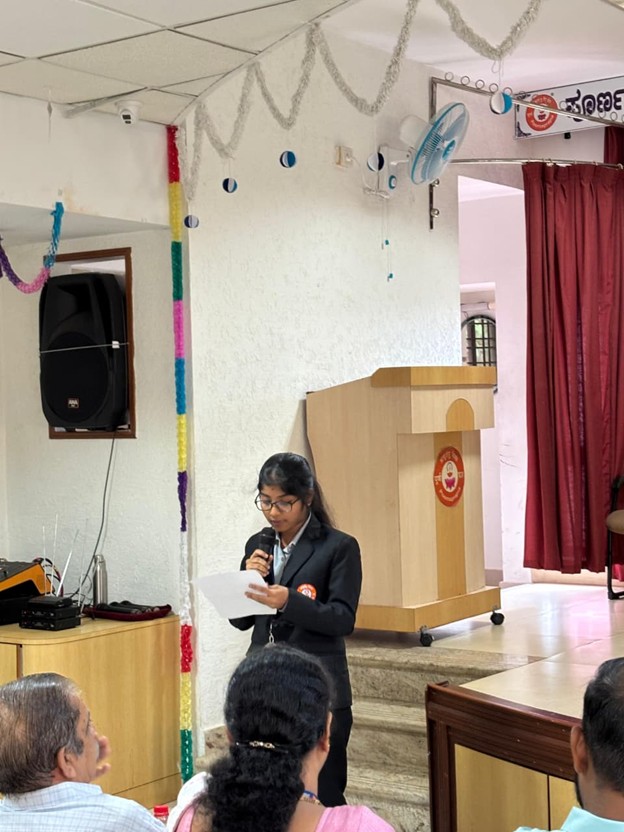
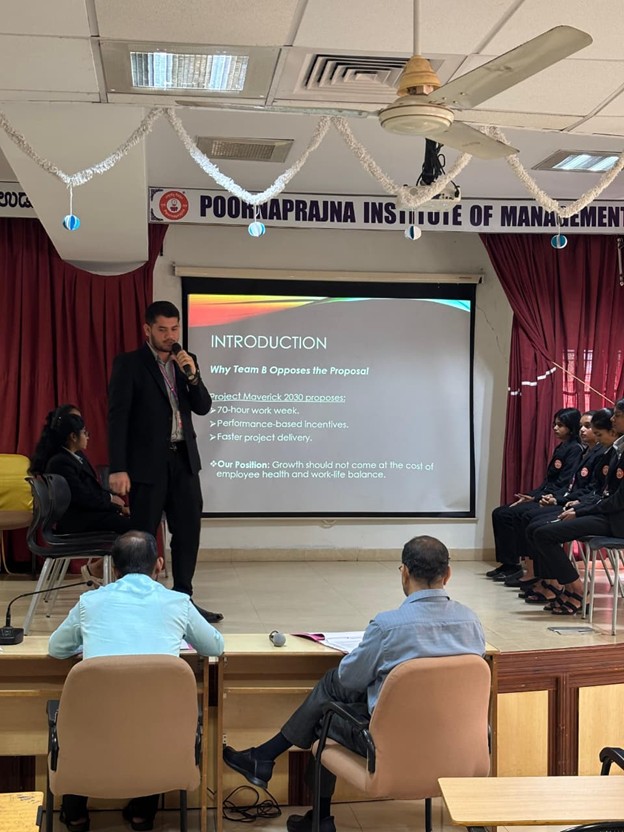
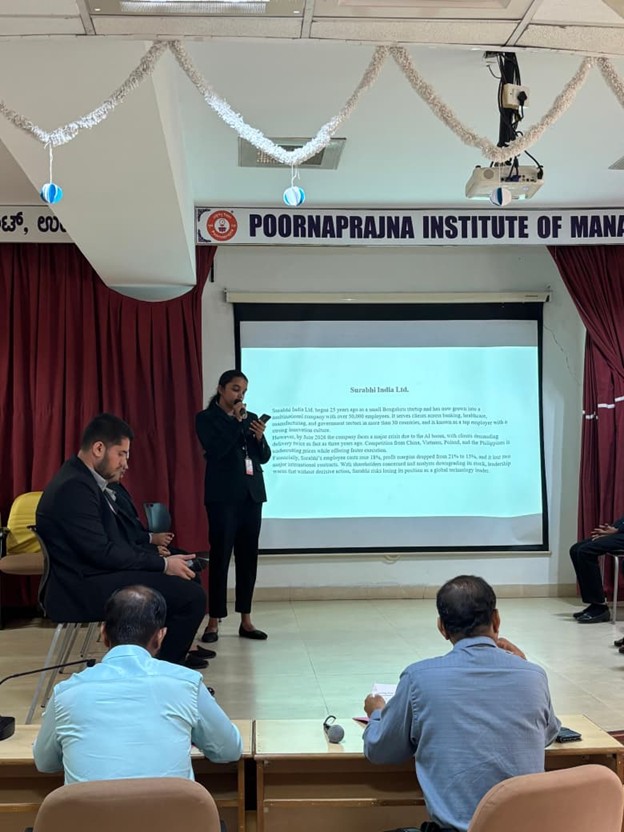
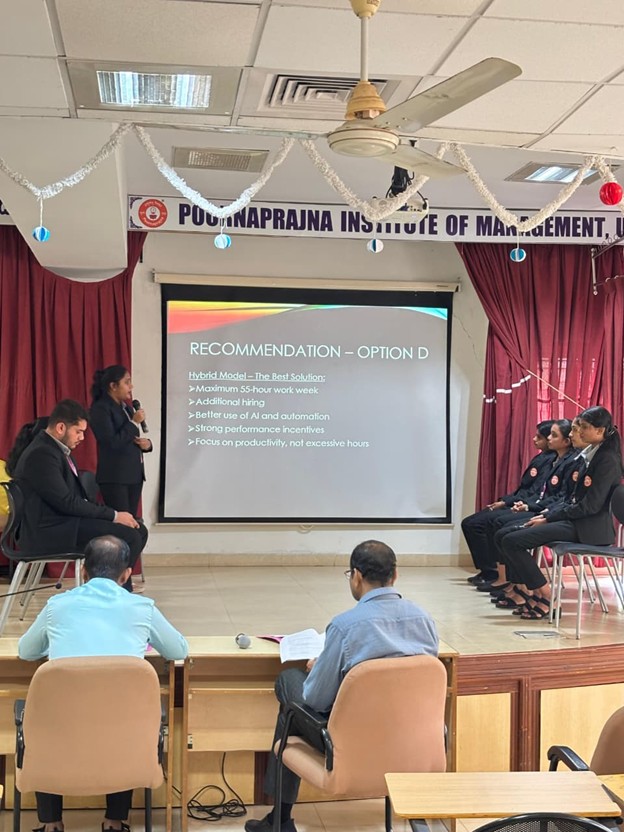
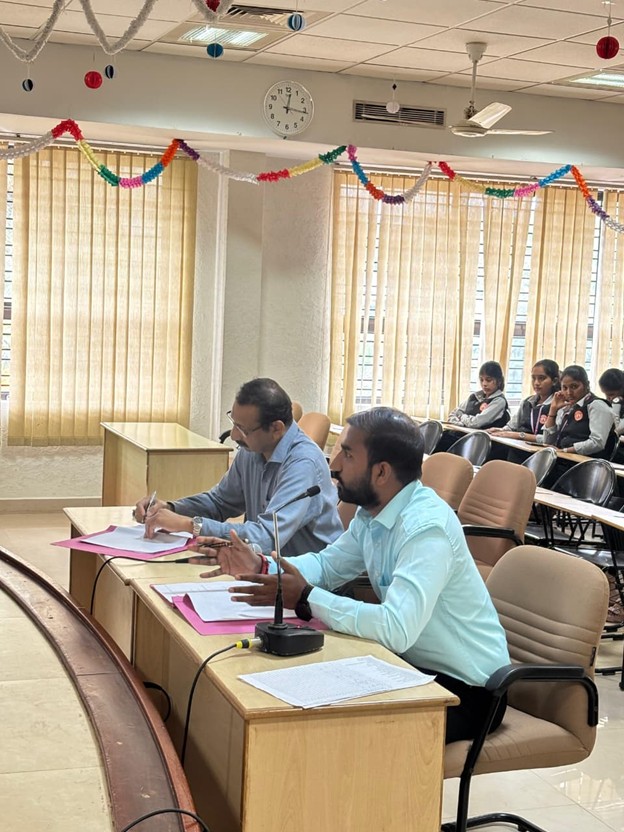
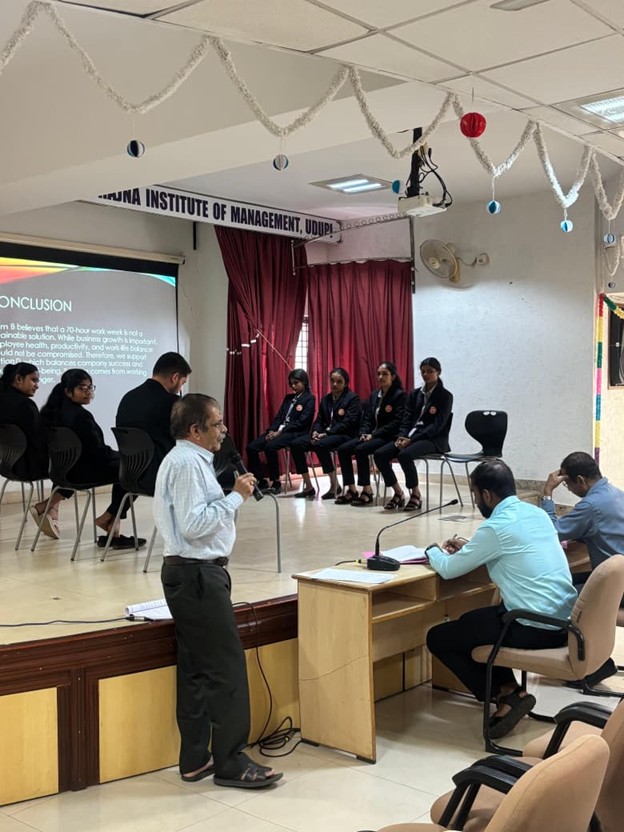
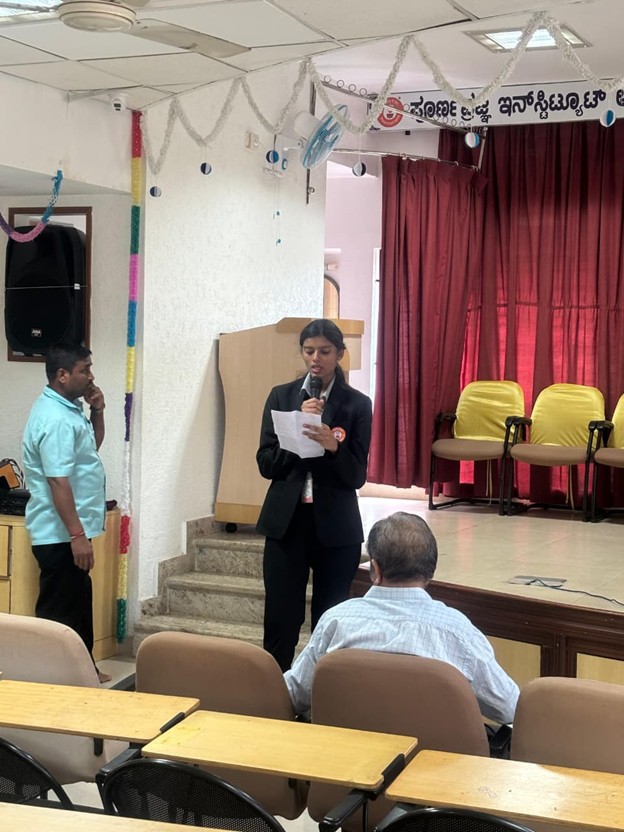
The Business Perspectives Session under Prajna Vaibhavam was conducted at the Prajna Hall of the Institute on 12th June 2026. The session featured case presentations by two teams from the First-Year MBA (2025–27 Batch), showcasing their critical thinking and analytical skills.
The two presenting teams and their business perspective cases were as follows:
The case assigned to the teams focused on “Project Maverick 2030 – The Future of Work at Surabhi India”, examining the proposal of a 70-hour work week, AI-enabled productivity, employee welfare, organizational competitiveness, and long-term business sustainability.
- Team B presented their business perspective opposing the proposal, highlighting concerns regarding employee well-being, work-life balance, and ethical considerations. The team advocated a hybrid approach involving moderate working hours, technology adoption, and strategic hiring to ensure sustainable organizational growth.
- Team L presented their business perspective supporting Project Maverick 2030, arguing that extended work hours with performance-based incentives would enhance productivity, strengthen global competitiveness, and improve shareholder value.
The session was attended by the Director of the Institute, Dr. P. S. Aithal, along with faculty members from the Department of MBA. Valuable feedback on the students’ performances was provided by Dr. Krishna Kothai. The business perspective was evaluated by the external judge, Dr. Bharat V, and faculty member Prof. Venkatesh Shetty.
The event commenced with a warm welcome delivered by Ms. Apreeta. The session was compered by Dr. Diana Saldanha, Faculty Coordinator for Prajna Vaibhavam. The session concluded with a vote of thanks delivered by Ms. Laressa.
Questions and Feedback for Team B and Team L
Following the presentations, an interactive question-and-answer session was conducted. Students, faculty members, and judges raised several insightful questions regarding the business perspectives put forward by Team B and Team L. The following questions were asked to the participants:
- Poornesh (Team E): Is declining profitability a sufficient justification?
- Chirag (Team J): How should leaders handle disagreements among stakeholders?
- Hena (Team K): Can AI tools improve productivity without increasing working hours?
- Ananth Krishna (Team I): Can participation truly be voluntary?
- Kavana (Team C): If 48% of employees already show burnout symptoms, how will a 70-hour work week improve productivity?
- Shreya (Team H): How might different demographic groups be affected?
- Shrivats (Team O): How would you manage the recruitment and retention process?
- Rakshitha (Team F): What responsibilities does a corporation owe its employees?
- Prathviraj (Team A): If delivery speed does not improve, how will Surabhi India prevent clients from moving to competitors?
In his concluding remarks, Dr. Krishna Kothai commented that the presentation required more detailed research and careful analysis regarding the technical aspects presented during the case discussion.
The session concluded successfully with active participation from students and faculty members. The Business Perspectives Round provided an excellent platform for MBA students to demonstrate their critical thinking, presentation skills, business acumen, and innovative ideas under the banner of Prajna Vaibhavam.