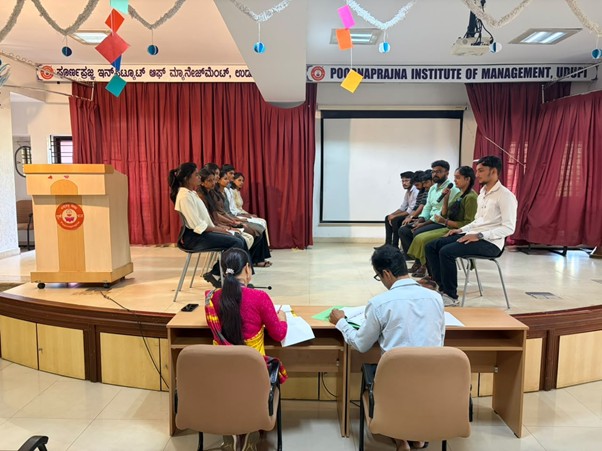
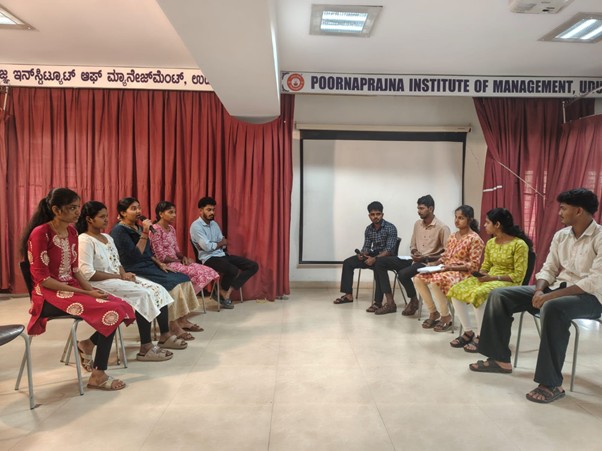
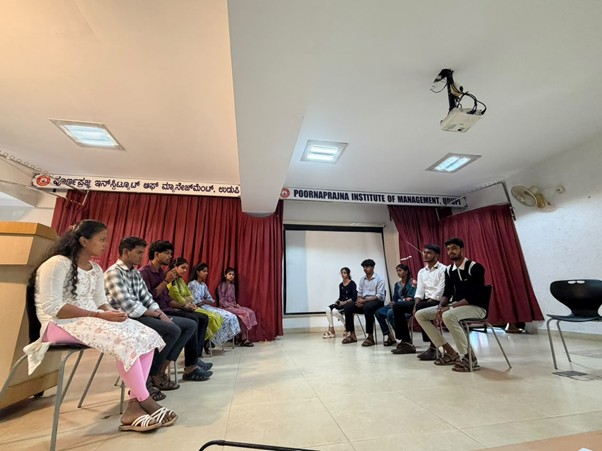
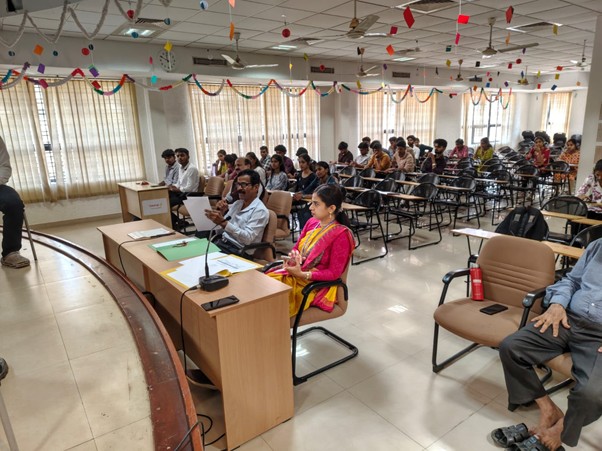
Prajna Vaibhavam (PV) organised Debate – Track 1 on Friday, 20 November 2026, from 11:15 a.m. to 1:00 p.m. at the PV Hall. The activity provided students with a platform to develop their debating skills, critical thinking, logical reasoning, persuasive communication, and ability to defend their viewpoints on contemporary organisational and business issues.
Three debates were conducted between the respective teams, covering topics related to employee productivity, human resource management, and marketing strategy. Each team was allotted 15 minutes for the debate, followed by a question-and-answer session. Immediate feedback was provided after each team’s performance to help students identify their strengths and areas for improvement.
Debate Topics and Team Participation
- Topic: Employee Productivity
Motion: Is a four-day workweek more effective than a traditional five-day workweek?
- Team A: Argued in favour of a four-day workweek.
- Team D: Argued in favour of a traditional five-day workweek.
The debate explored alternative workweek arrangements and their implications for employee productivity, work-life balance, organisational efficiency, and performance.
- Topic: Human Resources and Technology
Motion: Should companies prioritise hiring experienced employees over fresh graduates?
- Team J: Argued in favour of prioritising experienced employees.
- Team E: Argued in favour of prioritising fresh graduates.
The discussion examined the relative importance of professional experience and fresh talent in organisational recruitment, considering practical knowledge, adaptability, innovation, skill development, and long-term organisational requirements.
- Topic: Marketing Strategy
Motion: Should businesses focus more on customer retention than customer acquisition?
- Team F: Argued in favour of prioritising customer retention.
- Team B: Argued in favour of prioritising customer acquisition.
The debate focused on customer relationship management, brand loyalty, customer acquisition costs, business growth, and the importance of balancing existing customer relationships with the expansion of the customer base.
 Evaluation and Feedback
The debate round was evaluated by:
- External Judge: Prof. P. Kodancha
- Internal Judge: Dr. Diana Saldanha
The evaluation focused on the students’ ability to construct logical arguments, substantiate their viewpoints, counter opposing arguments, communicate persuasively, and demonstrate confidence and clarity while presenting their positions.
Feedback was provided immediately after the performances by:
- Dr. P. S. Aithal, Director, PIM
- Dr. Krishna Kothai, Professor Emeritus, PIM
The feedback offered students valuable insights into their debating techniques, quality of arguments, presentation skills, and ability to respond effectively to opposing viewpoints.
Prof. Ramakrishna, PV Coordinator, was also present during the event.
Student Coordinators and Responsibilities
The following students coordinated the proceedings of the debate:
| Responsibility | Student |
| Master of Ceremonies (MC) | Akshatharaj |
| Welcome Address | Anjana |
| Timekeepers | Rahul and Kanishka |
| Vote of Thanks | Adithi |
Learning Outcomes
The debate activity provided students with an opportunity to:
- Develop critical thinking, analytical reasoning, and persuasive communication skills.
- Construct logical arguments and support opinions with relevant examples.
- Understand different perspectives on contemporary management and business issues.
- Improve their ability to counter opposing arguments and respond spontaneously to questions.
- Build confidence in public speaking and professional communication.
- Develop teamwork, active listening, and time-management skills.
- Apply management concepts to practical organisational situations.
Conclusion
Debate – Track 1 of Prajna Vaibhavam provided an engaging and intellectually stimulating learning experience for the students. The three debates encouraged participants to examine contemporary workplace and business challenges from contrasting perspectives and defend their positions through logical reasoning and effective communication. The immediate feedback from the Director and Professor Emeritus further enriched the learning experience by offering constructive guidance for improvement. The activity reinforced the importance of critical thinking, confidence, and effective argumentation as essential competencies for future managers.